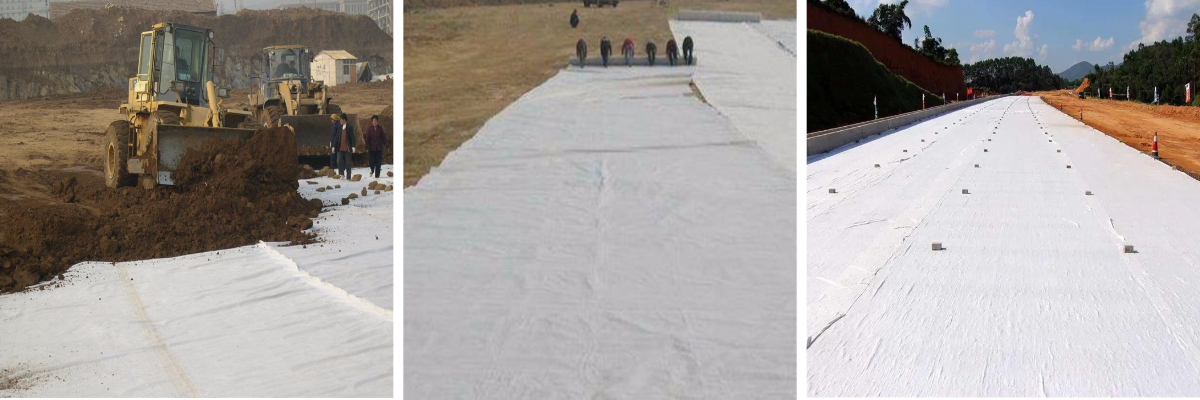
Geotextile for subgrade reinforcement
1. Reinforcement
Geotextiles are embedded within subgrade soils to utilize their high tensile strength for distributing load stress, enhancing the overall shear strength of the soil mass, and effectively preventing slippage and deformation. For example, laying geotextiles on soft soil foundations can increase bearing capacity by more than 40%.
2. Separation
Prevents the mixing of materials with different particle sizes (e.g., gravel and soft soil), maintaining the stability of individual structural layers and avoiding strength reduction caused by material intermixing.
Geotextile for subgrade reinforcement (Geosynthetic reinforcement fabric for subgrade stabilization) is a widely used geosynthetic material in engineering fields such as highways, railways, water conservancy, and airports. It is primarily employed to enhance foundation bearing capacity, prevent settlement, and improve structural stability. Through its five key functions—reinforcement, separation, drainage, filtration, and protection—it significantly improves the durability and safety of subgrade structures.

I. Core Functions and Mechanisms of Action
1. Reinforcement
Geotextiles are embedded within subgrade soils to utilize their high tensile strength for distributing load stress, enhancing the overall shear strength of the soil mass, and effectively preventing slippage and deformation. For example, laying geotextiles on soft soil foundations can increase bearing capacity by more than 40%.
2. Separation
Prevents the mixing of materials with different particle sizes (e.g., gravel and soft soil), maintaining the stability of individual structural layers and avoiding strength reduction caused by material intermixing.
3. Drainage
Utilizes the three-dimensional pore structure among fibers to form horizontal drainage channels that channelize water out of the subgrade, reduce pore water pressure, and prevent frost heave and mud pumping.
4. Filtration Protection
The "water-permeable but soil-retentive" characteristic prevents soil particle loss while allowing water to pass through, thereby protecting the integrity of the subgrade structure.
5. Protection and Cushioning
Mitigates damage to the subgrade caused by external impacts (e.g., wheel loads, freeze-thaw cycles), thus extending the service life of the pavement.

II. Key Construction Methods
1. Layered Laying Method
Fill soil in layers 30–50 cm thick. After laying the geotextile, continue filling and compact each layer progressively to ensure close integration between the geotextile and the soil.
2. Wrapped Reinforcement Method
The geotextile wraps around the outer edge of the fill to form a closed structure, enhancing overall stability. This method is suitable for high-fill sections.
3. Stepped Lap Method
Construct steps on the slope and lay the geotextile horizontally across these steps to prevent slippage. This method is appropriate for high-slope engineering projects.
4. Anchored End Treatment Method
Fix the ends using U-shaped nails or anchoring trenches to prevent displacement. This is a critical step in ensuring the effectiveness of reinforcement.