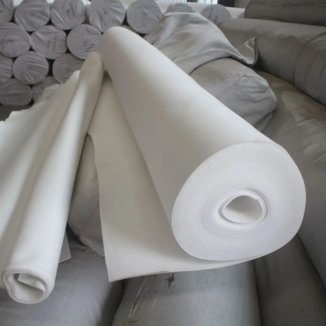
PP Geotextile Price
· High Resistance to Aging and Weathering
The material contains UV stabilizers, enabling long-term use in environments ranging from -60°C to +80°C. When installed in buried applications, its service life can exceed 20 years.
· High Friction Coefficient and Stability
The geotextile surface is rough, effectively increasing friction with overlying layers to prevent slippage, making it particularly suitable for slope protection projects.
one-fabric-one-membrane composite
A geosynthetic material composed of one layer of geotextile ("fabric") and one layer of polymer impermeable membrane ("membrane") bonded together through hot-melt or calendering processes, widely used in water conservancy projects, environmental anti-seepage, transportation infrastructure, and other fields, featuring high strength, excellent impermeability, and ease of construction.

I. Core Performance Characteristics
1. Excellent Waterproofing Capability
The permeability coefficient of the waterproofing membrane layer can be as low as K×10⁻¹¹ to 10⁻¹³ cm/s, making it virtually impermeable. It is suitable for engineering applications with extremely high waterproofing requirements, such as landfills, artificial lakes, and embankments.
2. Superior Mechanical Properties
· Tensile strength: 5–20 kN/m
· CBR puncture resistance: 1.1–3.2 kN
· Tear strength: 0.15–0.68 kNCapable of withstanding foundation deformation, settlement, and external loads, making it adaptable to complex geological conditions.
3. High Resistance to Aging and Weathering
The material contains UV stabilizers, enabling long-term use in environments ranging from -60°C to +80°C. When installed in buried applications, its service life can exceed 20 years.
4. High Friction Coefficient and Stability
The geotextile surface is rough, effectively increasing friction with overlying layers to prevent slippage, making it particularly suitable for slope protection projects.
5. Easy Installation and Cost-Effective
Supplied in roll form for convenient transportation and laying. Joints can be sealed via thermal welding or adhesive bonding to achieve continuous waterproofing. Additionally, it reduces requirements on the gradation of cushion layer particle size, thereby lowering construction costs.

II. Main Application Scenarios
1. Hydraulic Engineering
Used in anti-seepage linings for reservoirs, dams, canals, and water-conveyance tunnels to prevent water resource loss.
2. Environmental Protection Engineering
Applied as bottom anti-seepage systems in landfills, sewage treatment pools, tailings ponds, and similar facilities to prevent pollutants from infiltrating groundwater.
3. Transportation and Municipal Engineering
Employed as waterproofing layers in subways, tunnels, and highway subgrades to enhance structural durability.
4. Agricultural and Ecological Projects
Utilized in freshwater aquaculture farms, liquid storage ponds, and constructed wetlands, providing both seepage prevention and ecological protection functions.
5. Roof and Basement Waterproofing in Buildings
Used in special buildings for waterproofing applications in rooftop gardens, underground parking garages, and similar areas.