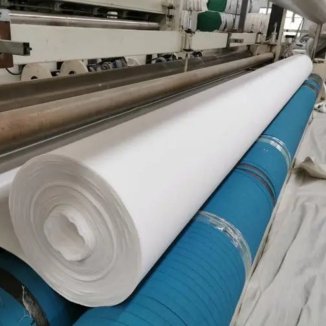
Road maintenance geotextile
• Reflective Crack Prevention
When overlaying an asphalt layer on an existing cement concrete pavement, geotextiles act as a stress-absorbing interlayer that disperses concentrated stresses at joints, preventing cracks from reflecting upward and enhancing pavement durability.
• Moisture Retention and Curing
Covering the surface of freshly poured concrete, geotextiles reduce moisture evaporation and prevent early-age shrinkage cracks caused by sun exposure and wind, ensuring proper curing quality.
Road maintenance geotextiles are key materials used in road and railway pavement engineering to prevent reflective cracking, retain moisture during curing, and provide dust protection, effectively extending the service life of roads. Made from synthetic fibers such as polyester through needle-punching or weaving processes, they feature high permeability, high tensile strength, corrosion resistance, and anti-aging properties, and are widely applied in scenarios such as asphalt overlay on old pavements and concrete curing.

I. Core Functions and Applications
• Reflective Crack Prevention
When overlaying an asphalt layer on an existing cement concrete pavement, geotextiles act as a stress-absorbing interlayer that disperses concentrated stresses at joints, preventing cracks from reflecting upward and enhancing pavement durability.
• Moisture Retention and Curing
Covering the surface of freshly poured concrete, geotextiles reduce moisture evaporation and prevent early-age shrinkage cracks caused by sun exposure and wind, ensuring proper curing quality.
• Dust Control and Protection
During construction, geotextiles cover subgrade or earthwork to suppress dust pollution, while also protecting the base layer from rain erosion and mechanical damage.
• Reinforcement and Separation
Geotextiles improve the structural integrity of flexible pavements and separate different material layers to prevent mixing, thereby maintaining subgrade stability.

II. Key Construction Points (Must Read)
• The pavement must be clean and dry.
Construction is prohibited under wet, icy, or extremely dusty conditions.
• The overlapping direction shall follow the traffic flow.
Lap joints shall not be against the traffic direction to prevent lifting by vehicles.
• Prolonged exposure to sunlight is strictly prohibited.
Asphalt surface course shall be paved as soon as possible after installation.
• Vehicles are forbidden from turning or braking directly on the fabric.
• Damaged areas must be repaired by overlapping, with a coverage of not less than 20 cm beyond the damage.