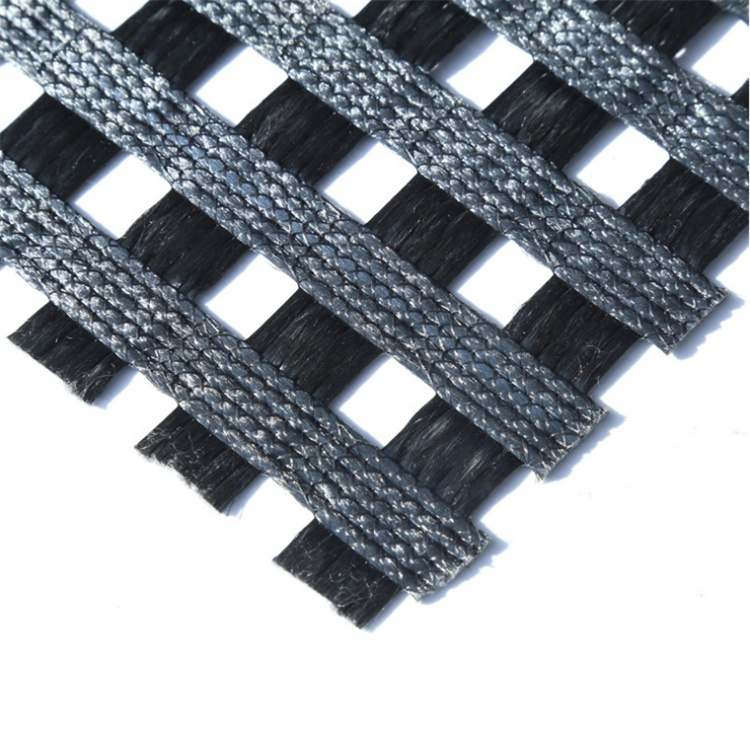

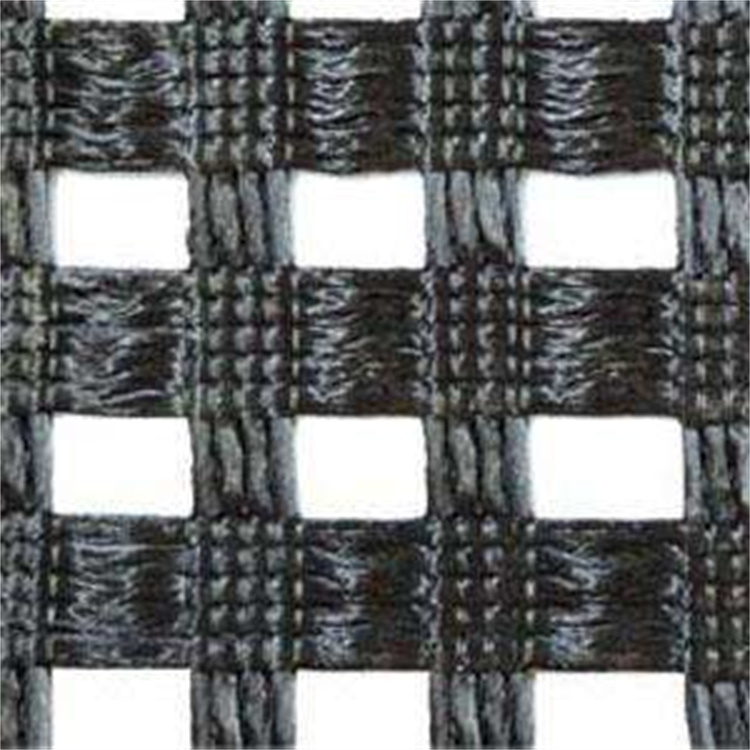


PET geogrid
Core Advantages
- Ultra-low Creep & Low Elongation: PET material features extremely low long-term creep and elongation ≤10%, ensuring long-term stability for 50–120 year permanent infrastructure.
- High Tensile Strength & High Modulus: Provides strong tensile resistance under small strain, effectively restraining subgrade deformation and pavement cracking.
- Excellent Chemical Resistance: Resists acid, alkali, salt and microbial corrosion, suitable for saline-alkali soil, mine soil and complex foundation conditions.
1. Product Overview
PET geogrid (Polyester Geogrid) is a high-performance woven geosynthetic material manufactured from high-tenacity polyester filament yarns. Through precise warp-knitting technology and special polymer coating (PVC, bitumen or SBR), it forms a rigid and stable grid structure with excellent tensile strength, low elongation and ultra-low creep performance.
PET geogrid is divided into uniaxial PET geogrid and biaxial PET geogrid. It interlocks with soil and aggregate to provide effective soil reinforcement, foundation stabilization and lateral restraint. Widely used in permanent transportation, hydraulic and slope stabilization projects.

2. Working Mechanism
PET geogrid stabilizes soil through physical interlocking and tensile reinforcement:
- Soil-Grid Interlock: The rigid grid structure locks soil particles and crushed stone, preventing lateral displacement and spreading of fill materials.
- Stress Dispersion: Transfers concentrated vertical loads into wide-range horizontal tension, reducing subgrade vertical stress and differential settlement.
- Low Creep Reinforcement: High-modulus polyester material maintains stable tensile performance under long-term sustained load, avoiding gradual deformation of the reinforced foundation.
- Integral Reinforcement Layer: Forms a composite flexible slab with soil, improving overall subgrade stiffness and anti-fracture capacity.
3. Core Advantages
- Ultra-low Creep & Low Elongation: PET material features extremely low long-term creep and elongation ≤10%, ensuring long-term stability for 50–120 year permanent infrastructure.
- High Tensile Strength & High Modulus: Provides strong tensile resistance under small strain, effectively restraining subgrade deformation and pavement cracking.
- Excellent Chemical Resistance: Resists acid, alkali, salt and microbial corrosion, suitable for saline-alkali soil, mine soil and complex foundation conditions.
- Strong Temperature & Aging Resistance: Stable performance under freeze-thaw cycles and long-term outdoor exposure.
- Perfect Interlocking Performance: Regular grid mesh forms powerful mechanical interlock with aggregate, greatly improving soil shear strength.
- Cost-effective & Easy Installation: Lightweight, flexible and easy to cut and lay; reduces filling thickness and overall project cost.
4. Main Specifications
Material: High-tenacity polyester filament (PET) with PVC / Bitumen / SBR coating
Type: Uniaxial PET Geogrid / Biaxial PET Geogrid
Strength Range:
- Biaxial: 50/50kN/m – 200/200kN/m
- Uniaxial: 80kN/m – 800kN/m
Mesh Size: 12.7mm, 25.4mm, 40mm (customizable)
Elongation at Break: ≤10%
Width: 1m – 6m
Certification: CE, ISO9001, SGS

5. Application Scenarios
- Road & Railway Subgrade Reinforcement: Soft soil foundation treatment, old-new subgrade splicing, rutting and settlement control.
- Retaining Wall & Abutment Backfill: Uniaxial PET geogrid is the preferred material for geogrid reinforced earth walls and bridge abutment stabilization.
- Slope Stabilization & Erosion Control: High-fill slope reinforcement, landslide prevention, coordinate with hydroseeding for ecological restoration.
- Heavy-duty Yard Reinforcement: Port yard, logistics park, airport apron and industrial storage ground stabilization.
- Hydraulic Engineering: River embankment, dam and channel slope reinforcement.
6. Standard Construction Steps
1. Level and compact the subgrade, remove sharp stones and organic soil to avoid grid damage.
2. Lay PET geogrid flat and tensioned without wrinkles; ensure the main force direction is consistent with the structural stress direction.
3. Overlap adjacent grids with overlapping length ≥200mm, fix with stakes or connectors.
4. Backfill aggregate or soil in time and compact layer by layer; avoid heavy machinery rolling directly on the uncovered grid.
5. Cover with soil or pavement structure as soon as possible to prevent long-term UV exposure.