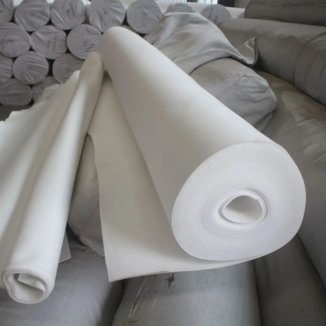
Polyester Geotextile
Excellent Environmental Resistance
· Resistant to high temperatures up to 230°C, maintaining structural integrity under heat;
· High UV resistance, suitable for long-term outdoor exposure;
· Highly tolerant to chemical substances such as acids, alkalis, microorganisms, gasoline, and diesel.
Polyester geotextile is a geosynthetic material primarily made from polyester fibers (PET), widely used in various civil and geotechnical engineering applications. It possesses high tensile strength, corrosion resistance, anti-aging properties, UV resistance, as well as excellent water permeability and filtration performance.

I. Key Features
1. High Strength and Reinforcement Performance
The three-dimensional network structure formed by polyester filament fibers provides excellent tensile strength and creep resistance. It outperforms other types of nonwoven fabrics at the same unit weight, effectively enhancing the overall stability of foundations.
2. Superior Drainage and Filtration Function
The material has a loose structure with tortuous pore distribution, enabling efficient planar drainage and vertical water permeability. At the same time, it prevents soil particle loss, fulfilling a "water-permeable but soil-retentive" filtration function.
3. Excellent Environmental Resistance
· Resistant to high temperatures up to 230°C, maintaining structural integrity under heat;
· High UV resistance, suitable for long-term outdoor exposure;
· Highly tolerant to chemical substances such as acids, alkalis, microorganisms, gasoline, and diesel.
4. Good Ductility and Adaptability
Conforms well to uneven substrates, accommodates settlement and deformation, and prevents localized tearing.

II. Main Application Areas
1. Hydraulic Engineering
Used in anti-filtration layers, anti-seepage isolation layers, and drainage systems for embankments, reservoirs, and riverbank protection, preventing damage caused by seepage.
2. Transportation Infrastructure
Applied in subgrade reinforcement, slope protection, pavement reinforcement, and reflective crack prevention in overlaying of old roads for highways, railways, and airport runways.
3. Environmental Protection Engineering
Serves as a protective layer and drainage layer for anti-seepage membranes in landfills and tailings ponds, preventing leachate from polluting the environment.
4. Ports and Soft Ground Treatment
Utilized in coastal dikes, seaport wharves, and soft soil foundation reinforcement to enhance bearing capacity and control settlement.
5. Ecological Restoration
Integrated with vegetated slope protection techniques to achieve a unified approach combining engineering protection with ecological greening.