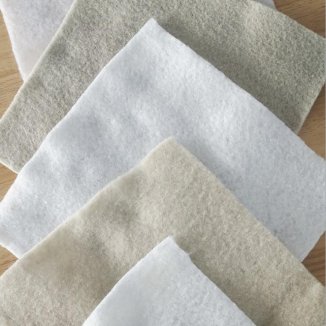
Woven polypropylene geotextile
· High Strength: The specification range is usually 35-250kN/m, with tensile strength much higher than that of nonwoven geotextiles of the same weight. Its puncture resistance can reach more than 2200 Newtons, which can effectively resist the impact of stones.
· Low Elongation: It has low elongation under load (usually <25%), which can effectively control foundation deformation and prevent reflective cracks on the road surface.
· Chemical Resistance: It performs stably in acidic and alkaline environments with a pH value of 2-13, and is resistant to mildew and insect damage.
· Permeability: The vertical permeability coefficient is controllable, which can not only drain water but also act as a filter to prevent piping.
Woven polypropylene geotextile is a permeable geosynthetic material made from polypropylene (polypropylene) long fibers or flat yarns through a weaving process. With extremely high tensile strength, stable pore structure and excellent acid and alkali resistance, it has become a core reinforcement material in road reinforcement, hydraulic slope protection and soft foundation treatment projects.

I. Core Process and Structural Features
Unlike the random fiber arrangement of needle-punched nonwoven geotextiles, polypropylene woven geotextile adopts a strict warp and weft interlacing structure, which gives it unique mechanical properties:
· Woven Formation: It is made by using wide-width shuttle looms, rapier looms or air-jet looms to interlace polypropylene flat yarns or long fibers at a specific density in the warp and weft directions. This process endows the material with extremely high tensile strength in both warp and weft directions, while the diagonal strength is relatively low. It is particularly suitable for engineering scenarios that bear unidirectional or bidirectional tensile loads.
· Structural Stability: The warp and weft yarns compress each other to form a stable grid structure with uniform pore size that is resistant to deformation. This structure not only provides powerful reinforcement function, but also effectively prevents soil particle loss, while maintaining excellent permeability.
· Raw Material Advantages: As the raw material, polypropylene (Polypropylene) has a small density (lighter than water) and high strength. It also has strong resistance to acids, alkalis and organic solvents, making it especially suitable for long-term use in corrosive soils or sewage environments.

II. Typical Engineering Application Scenarios
· Road and Railway Embankment Reinforcement: Laid between soft subgrades and fill materials, it utilizes its high modulus to distribute vehicular loads, enhance embankment bearing capacity, and reduce uneven settlement and reflective cracks.
· Water Conservancy and Coastal Engineering: Applied in dike slope protection, river channel management, and breakwater construction. Its high-strength grid structure can resist water erosion and wave impact, while also serving as a filter to protect the soil.
· Port and Yard Reinforcement: In heavy-load areas such as container yards and backfill zones behind docks, high-strength polypropylene woven geotextile can significantly extend the service life of the project and reduce maintenance costs.
· Land Reclamation and Filling Bags: Taking advantage of its high strength and permeability, it is used to make geotextile bags or concrete-filled bags for rapid dike construction and shore protection.