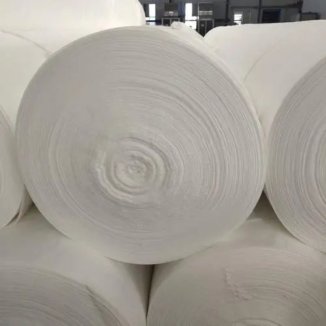
Rolls of composite geomembrane: size 50×4 m, density 150 g/m², thickness 0.5 mm, top layer 150 g/m².
Rubber drainage tapes: GB standard.
Geomembrane Price
·High level of water resistance:An extremely low filtration coefficient of 1×10⁻¹⁷ cm/s guarantees effective protection against water penetration.
·Wide operating temperature range:Functions reliably in conditions from -70 °C to +110 °C without loss of properties.
·Excellent chemical resistance:It has high resistance to aggressive acids, alkalis and petroleum products, making it ideal for anti-corrosion solutions.
·High mechanical reliability:It features increased tensile and tear strength, meeting the requirements of high-end engineering facilities.
·Resistance to aging and climate influences:Maintains stable performance characteristics during long-term outdoor use.
·Adaptability to difficult conditions:High elongation at break ensures safety and integrity under uneven settlement and difficult geological conditions.
·Environmental safety:Made from virgin HDPE resin and carbon black, it does not contain any harmful or toxic additives.
Product Details
Product description
Geomembrane is a waterproof barrier material made of high-density polyethylene with a density of at least 0.94 g/cm³. It is widely used in containment projects, including municipal solid waste landfills, wastewater treatment plants and artificial reservoirs, and is used in the fields of environmental protection, water management and municipal construction. UV protection is provided by the introduction of anti-aging additives and carbon black, which allows achieving an ultra-low permeability coefficient of 1×10⁻¹⁷ cm/s. The material is resistant to acid and alkaline corrosion and can withstand exposure to more than 80 types of chemical environments, while its service life exceeds 50 years.
The geomembrane has a tensile strength of up to 28 MPa and an elongation at break of about 700%, as well as high resistance to punctures and cracking under the influence of environmental factors. It operates reliably in the temperature range from −60 °C to +60 °C. Installation is carried out by hot welding with mandatory control of the overlap width and temperature parameters. The use of composite structures (one fabric - one film / two fabrics - one film) increases the overall stability of the project. Products comply with GB/T 17643-2011 standard, are available in thicknesses from 0.25 to 3.0 mm and can be manufactured to individual requirements, including smooth or textured surfaces.

Advantages
Simple design:all you need to do is dig a pit and level the base; There is no need to install a concrete foundation.
High installation speed:there is no need to wait for hardening time, as is the case with monolithic concrete.
Resistance to base deformation:HDPE geomembranes have high elongation at break, which allows them to compensate for foundation settlement and deformation.
Excellent performance properties:This is one of the most important advantages of HDPE geomembranes.
Possibility of dismantling and restoration:The most noticeable feature of HDPE geomembranes is that after use they can be easily rolled up, the excavation pit can be backfilled, and the area can be returned to its original state.

Construction process
I. Sequence of work
● Excavation of a foundation pit
● Application of a protective layer of cement mortar to the bottom of the reservoir (thickness 20–30 mm)
● Trimming, compaction and alignment of slopes
● Fastening a composite geomembrane to a vertical retaining (water-retaining) wall
● Leveling the base, cleaning the site and intermediate handover of works
● Sealing and waterproofing of underwater pipelines
● Laying out and welding composite geomembrane
● Delivery of completed work
● Quality control of welded seams and elimination of defects
● Final acceptance of the object
II. Project overview
Maximum design water level:about 0.6 m.
Total waterproofing area:approximately 800 m².
Water retention wall:made of expanded clay concrete blocks.
Relief features:There are flooded pits.
III. Basic waterproofing materials
IV. Foundation condition

V. Welding and assembly techniques
1. Welding technique:
①Overlap and fold parameters:overlap width 80–100 mm; natural folds: 5–8% on horizontal and vertical surfaces; allowance for expansion 3–5%; allowance for trimming 2–5%.
②Hot welding:temperature 280–300 °C; travel speed 2–3 m/min; welding is performed with a double seam.
③Damage repair:cut out pieces of identical material, connect them using hot welding and additionally seal them with polyethylene glue.
④Joints without fabric reinforcement:must be performed by mechanical stitching.
⑤Sealing of underwater pipes:Use GB standard rubber drainage tapes, wrapped in metal and protected against corrosion.
2. Styling technique:
①Layout direction:The composite geomembrane is rolled out from east to west or from west to east. The length of each section must accommodate the height of the retaining wall on both sides and be laid in a single pass.
②Laying sequence:move from the channel axis to the south and north sides.
③Construction stages:First, apply a 20-30 mm thick protective layer of mortar to the bottom of the reservoir, then glue the geomembrane to the vertical water-retaining wall.
④Bonding to retaining walls:Apply adhesive to the contact surfaces of the geomembrane and the wall. Allow the adhesive to dry and set for approximately 5 minutes before pressing and smoothing. The adhesive consists of a mixture of asphalt emulsion, cement, and water. After bonding, secure the geomembrane with rivets above the water level and apply a waterproof and anti-corrosion coating.
VI. Quality Acceptance
Standard Compliance: Composite geomembranes and their structures shall comply with the national standards for polyethylene and composite geomembranes approved by the State Administration for Market Regulation.
Acceptance of construction quality: includes self-checking by the construction organization and random checking by the contractor.
Weld inspection is performed using the inflation pressure method, and defect repair is performed by visual inspection. The test inflation pressure is 0.06 MPa.
Acceptance stages: The quality acceptance process includes the transfer of work between stages and final acceptance after all work is completed.
Normal seepage rate for artificial reservoirs: ≤15 mm/24 h, including seasonal water losses due to evaporation.
VII. Construction schedule
1. Daily Capacity: One unit can cover 2000-2500 m² per day.
2. Planned construction period: 3 days.
VIII. Recommendations
Strengthening control and raising awareness:It is necessary to ensure reliable protection and management of composite geomembranes while simultaneously improving construction personnel's knowledge of waterproofing technologies. This is critical to ensuring project quality and timely commissioning of the facility.
Assignment of responsible personnel:The contractor is obligated to notify and assign specialists to supervise workers handling waterproofing materials. Any damage to composite geomembranes must be reported immediately to waterproofing crews for prompt repair.
Pollution Prevention:Geomembranes should not be allowed to come into contact with oil, as this reduces adhesion. Detailed storage and protection procedures are described in the section "Introduction to Construction Methods Using Geomembranes."
Key points during project implementation:
① After welding the composite geomembranes into finished products, a protective layer of solution is first applied to the bottom of the reservoir.
② For waterproofing the bridge foundation, a method of welding reinforcement through a membrane with a protective layer of mortar is used, which reduces the risks associated with the quality of the welds.
③ When bonding composite geomembranes to walls, it is necessary to avoid the formation of large voids.

Application scenarios
HDPE geomembranes for environmental protection and sanitation:Suitable for landfills, wastewater treatment plants, control basins of power plants, as well as for the disposal of solid waste from industrial enterprises and medical institutions.
HDPE geomembranes for water management projects:They are used to prevent seepage, seal leaks, strengthen the embankments of rivers, lakes, reservoirs and dams; protect canals, vertical walls with a core, slopes and other hydraulic structures.
Municipal construction:Applications in subway systems, underground structure foundations, green roofs, roof gardens and for sealing sewer pipes.
Landscape architecture:construction of artificial lakes, waterways, reservoirs, ponds on golf courses, slope protection and waterproofing of landscaped lawns.
HDPE geomembranes for the petrochemical industry:Chemical plants and oil refineries; preventing oil leakage from storage tanks, lining chemical reaction tanks, secondary lining of settling tanks, etc.
Polyethylene geomembranes for the mining industry:washing and screening ponds, heap leach ponds, ash storage facilities, dissolution ponds, settling ponds, tailings lining and seepage prevention.
HDPE membranes for transport infrastructure:Strengthening road foundations and sealing culverts.
HDPE geomembranes for agriculture:Sealing of drinking water tanks, domestic water bodies, waste treatment areas and irrigation systems.
HDPE geomembranes for aquaculture:Intensive and industrial fish ponds, shrimp ponds, pond lining and slope protection for sea cucumber enclosures.
HDPE geomembranes for salt production:Salt field crystallization ponds, brine pond liners, salt membranes and plastic liners for salt ponds.

Company Profile

Shandong Yuanpeng Environmental Protection Technology Co., Ltd. was founded in 2022 with a registered capital of 50 million yuan. Today, the company employs over 300 people and operates a 35,000-square-meter production facility. Yuanpeng boasts professional R&D teams and is a comprehensive enterprise integrating production, sales, and after-sales service.
Some of the company's production lines are fully automated. Annual sales volume reaches 120 million yuan. The company has established long-term partnerships with organizations such as CREC, CSCES, CCCC, MCC Group, POWERCHINA, Tongyuan Design Group, CSMDI, BMEDI, and others.


Leave your messages


Related News
Main Application Fields of Polyester Geogrid
2026-09-20
Core Advantages of Polyester Geogrid
2026-09-20