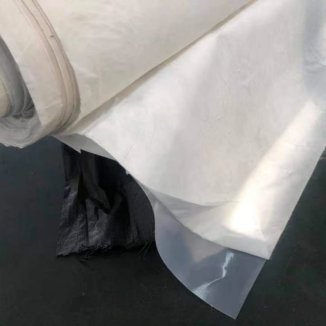
What is geotextile?
Geotextile is the general name for “geotextile fabric”. It is a permeable, flat, fabric-like material made from synthetic fibers by needlepunching or weaving. It belongs to the most fundamental and widely used branch in the family of geosynthetics.
Simply put, it can be thought of as a "specialty fabric" used in engineering projects. Buried or laid in the soil, it performs functions such as filtration, drainage, separation, protection and reinforcement.

For a more complete understanding, let's first look at its classification and main characteristics:
| Type | Main production process | Main structural characteristics | Basic functions |
|---|---|---|---|
| Non-woven geotextile | Needle punched, heat bonded or chemically bonded | The random arrangement of fibers, irregular and interconnected pores, resembles felt in appearance. | Filtration, drainage, protection, separation. |
| Woven geotextile | Traditional weaving process | Interweaving of warp and weft threads, dense structure, regular pores, high strength, externally reminiscent of woven bags. | Reinforcement, separation, protection, with pronounced directional strength. |
| Knitted geotextile | Knitting process | Less common, has a certain elasticity. | Reinforcement and protection in specific areas. |
Among them, non-woven geotextiles (especially needle-punched non-woven fabrics) are the most widely used and common type in the market due to their outstanding comprehensive properties.

In-Depth Analysis: Key Differences Between Nonwoven and Woven Geotextiles
We've previously looked at woven geotextiles, but now we'll focus on comparing their key differences with nonwoven geotextiles—differences that determine their different applications:
| Comparative aspect | Non-woven geotextile (needle-punched) | Woven geotextile |
|---|---|---|
| Main function | Excellent water permeability and filtering capacity, effectively passes water, preventing the removal of soil particles. | High tensile strength and excellent separating properties, withstands significant loads and prevents mixing of materials. |
| Mechanical properties | Relatively good isotropy (properties are similar in the longitudinal and transverse directions), high relative elongation, ability to withstand significant deformations. | Pronounced anisotropy (high strength in the warp and weft, low in other directions), low relative elongation. |
| Typical Applications | Drainage layers of road surfaces, filter layers at solid waste landfills, filter layers under coastal protection structures, landscaping works. | Road surface reinforcement requiring high tensile strength; geogrid base; separating layers to prevent aggregate subsidence. |
Main functions and application scenarios
Based on the above characteristics, geotextiles play an indispensable role in engineering projects:
Filtration and reverse filtration: this is their most classic function. Placed between soil and water or drainage materials, it acts as a "sieve," allowing water to pass through and preventing soil particles from being washed away, thereby protecting foundations or structures from erosion.
Application: filter layers under protective structures of river banks and coastal slopes; wrapping material around drainage blind ditches and drainage pipes.
Separation: Placed between materials with different properties (e.g. gravel base layer and soft foundation soil) to prevent mixing, maintaining the structural integrity and functionality of each layer.
Application: separation of ballast/crushed rock from underlying soft soil in railway and highway foundations; separation of individual soil layers in parking lot and sports ground foundations.
Drainage: Using the internal three-dimensional porous structure to form drainage channels in the soil, directing water flow outward and reducing pore water pressure.
Application: vertical drainage behind retaining walls; horizontal drainage layers when processing soft soil.
Protection: Acts as a buffer layer, distributing loads and reducing damage to soil or waterproofing materials (e.g. geomembranes) from external forces.
Application: Placed above/below geomembranes to prevent punctures from sharp rocks; used in soil protection to prevent erosion.
Reinforcement: Uses tensile strength to distribute soil loads, limit lateral movement and improve soil stability (woven geotextiles excel at this function).
Application: Reinforcement of foundations on soft soils, geotextile-reinforced retaining walls and stabilization of steep slopes for landscaping.
Summary and comparison: positioning in the geosynthetic family
Now let's clearly compare the main functions of the four main geosynthetic materials you asked about:
| Material | Basic form | Main function | Typical Applications |
|---|---|---|---|
| Cement blanket | Flexible felt impregnated with cement | Fast curing, surface protection | Urgent work, channel lining |
| Geotextiles (especially non-woven) | Permeable fabric (felt-like) | Filtration, drainage, separation, protection | Road drainage, filter layer for slope protection, filter layers at landfills |
| Geogrid | High-strength regular mesh | High-strength reinforcement, soil stabilization | Strengthening weak foundations, reinforced soil retaining walls |
| Geomembrane | Continuous impermeable film | Waterproofing, liquid/gas insulation | Solid waste landfills, reservoir waterproofing |
Thus, geotextiles, especially nonwoven geotextiles, serve as a versatile "all-purpose" material and "filter" in engineering projects. When projects require solutions for drainage, filtration, protection, or foundation insulation, geotextiles are often the material of choice.
If you would like to understand specific selection criteria and construction methods for geotextiles in specific projects, such as highway drainage design or landfill lining systems, I can provide more detailed information.