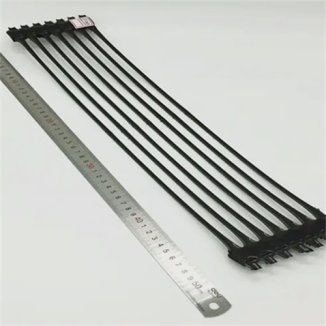
Polyester Staple Fiber Geotextile
Strong Environmental Adaptability
· Resistant to acids, alkalis, and corrosion, with stable performance within a pH range of 2–12;
· Resistant to microbial degradation and not susceptible to insect damage;
· Offers moderate UV resistance, suitable for short-term outdoor construction use.
Polyester staple fiber geotextile is a type of geosynthetic material made primarily from polyester staple fibers (PET or PP) through nonwoven processes including opening, carding, web laying, and needle-punching. It offers advantages such as low cost, excellent water permeability, ease of construction, and reinforcement protection, making it one of the most widely used geotextile types in municipal engineering and conventional infrastructure projects.

I. Core Features
1. Excellent Mechanical and Reinforcement Properties
Although its strength is slightly lower than that of filament geotextiles, staple fiber geotextile still possesses sufficient tensile strength and tear resistance. It effectively distributes foundation stress, prevents soil sliding and differential settlement, and is suitable for general soil reinforcement applications.
2. Superior Filtration and Drainage Performance
The material has a loose structure and high porosity, allowing water to pass through smoothly while effectively retaining fine soil particles. This achieves a "water-permeable but soil-retentive" filtration effect, making it widely used in drainage systems for slope protection and retaining walls.
3. Strong Environmental Adaptability
· Resistant to acids, alkalis, and corrosion, with stable performance within a pH range of 2–12;
· Resistant to microbial degradation and not susceptible to insect damage;
· Offers moderate UV resistance, suitable for short-term outdoor construction use.
4. Good Flexibility and Ease of Installation
The material is soft and adaptable to uneven substrates. It is resistant to damage during installation, easy to overlap, and compatible with conventional machinery, enabling large-area construction and significantly improving construction efficiency.

II. Main Application Areas
1. Transportation Infrastructure
Used as a subgrade separation layer in highways, railways, and airport runways to prevent ballast from mixing with soft soil and reduce frost heave; can also serve as an overlay on existing pavements to delay the formation of reflective cracks.
2. Water Conservancy Projects
Employed as slope and channel lining material in rivers, canals, and embankments to prevent soil erosion; used as a reservoir filter layer to ensure stable seepage flow and prevent piping failure.
3. Environmental and Municipal Engineering
Serves as part of the impermeable system in landfills and tailings ponds, installed above and below HDPE membranes to provide protection, filtration, and drainage functions, preventing puncture by sharp objects.
4. Slope Stabilization and Ecological Restoration
Combined with grass planting techniques for slope protection, effectively stabilizing soil while promoting vegetation growth, thus integrating engineering slope protection with ecological greening.
5. Temporary and Maintenance Engineering
Due to its high cost-effectiveness, it is commonly used in temporary roads, construction access roads, and pavement curing covers, ensuring construction quality and safety.