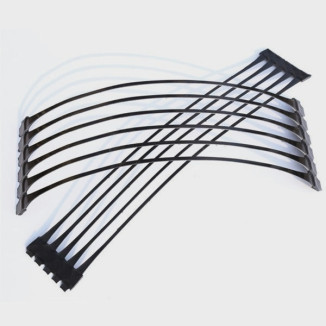
Cellular Confinement Systems (CCS) for Subgrade Stabilization — Advantages
1. Powerful 3D Lateral Confinement (Core Advantage)
The honeycomb cellular structure locks granular infill materials. Under vertical traffic load, the cell walls generate hoop stress to restrict lateral displacement of aggregate. It significantly improves soil shear strength, effectively preventing pavement rutting, shoving and surface unevenness.
2. Uniform Load Distribution (Snowshoe Effect)
Concentrated wheel loads are dispersed over a wider subsoil area. Vertical stress transferred to the underlying soft foundation is reduced, which greatly controls differential settlement, especially suitable for old-new subgrade splicing and collapsible loess, silt soft subgrade reconstruction projects.
3. Reduce Required Thickness of Base Cushion
CCS forms a rigid composite slab together with fillers. It can cut the designed thickness of gravel cushion by 50%–80%. Less excavation and less aggregate consumption, lowering raw material, transportation and earthwork costs.
4. Adaptable to Weak & Complex Foundation
Works well on silt, loess, backfilled soil and other poor ground where traditional gravel pavement is prone to sinking. Avoid large-scale deep excavation and soil replacement which are often restricted by design conditions.
5. Accelerate Construction Progress
CCS is delivered folded and compact, cutting transport volume drastically. On-site unfolding, anchoring and filling are simple, and no large heavy machinery is compulsory. The overall construction period can be shortened by around 20%–30% compared with conventional foundation treatment schemes.
6. Long-term Durability & Low Maintenance
Manufactured from modified virgin HDPE blended with anti-UV, antioxidant additives. It resists acid, alkali, freeze-thaw cycles and outdoor aging, with a design service life of 50–75 years. The stabilized substructure reduces later pavement repair frequency.
7. Flexible Structure Performance
CCS possesses good flexibility. It can accommodate slight foundation deformation without brittle fracture, unlike rigid concrete structures. It avoids continuous longitudinal cracks commonly occurring at old-new road splicing sections.