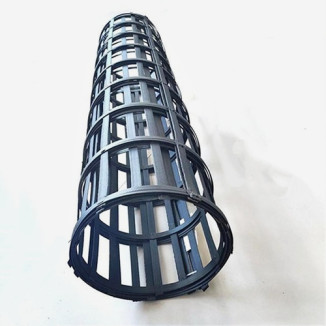
Honeycomb geocell
Detailed Explanation of Key Advantages
1. Enhanced Foundation Bearing Capacity and Stability
2. Superior Resistance to Deformation and Settlement
3. Convenient and Efficient Construction
4. Eco-Friendly and Promotes Vegetation Growth
5. High Durability and Adaptability to Harsh Environments
A geocell, also known as a honeycomb geocell, is a three-dimensional honeycomb-like structural material made of high-strength polymers such as high-density polyethylene (HDPE). It is widely used in engineering fields such as subgrade reinforcement, slope protection, and ecological restoration. Its core advantage lies in combining mechanical performance with ecological functionality to achieve a stable effect of "overcoming rigidity with flexibility."

I. Detailed Explanation of Key Advantages
1. Enhanced Foundation Bearing Capacity and Stability
The honeycomb structure forms a "three-dimensional confinement" on the filled soil through its 3D grid, effectively distributing loads and preventing lateral soil displacement. Experimental data show that after using geocells, the bearing capacity of soft soil foundations can increase by more than 50%, with settlement reduced by 47%. This makes it especially suitable for heavy-load engineering projects such as highways and airport runways.
2. Superior Resistance to Deformation and Settlement
Compared to traditional geogrids, geocells perform better in controlling differential settlement. Research indicates that when two layers of geocells are installed, differential settlement is reduced by 7.8% compared to unreinforced conditions, achieving twice the effectiveness of geogrids. While multi-layer installation can further improve performance, two layers represent the optimal cost-benefit solution.
3. Convenient and Efficient Construction
The material can be folded for transport and simply unfolded on site, secured with anchor pins, filled with soil, and compacted—requiring no heavy machinery. Lightweight and easy to operate, a single worker can complete the installation. Construction speed is over three times faster than concrete slope protection, significantly reducing project duration and labor costs.
4. Eco-Friendly and Promotes Vegetation Growth
The cells can be filled with topsoil and seeded, providing a three-dimensional growing space for plant roots and creating a "breathable" slope protection system. With excellent permeability and air circulation, the structure retains moisture and nutrients, enhancing vegetation coverage while reducing soil erosion by up to 60%. Over time, the combined action of plant roots and the cell structure results in slope reinforcement that becomes "stronger with use."
5. High Durability and Adaptability to Harsh Environments
Made from HDPE material, geocells are resistant to UV radiation, acids, alkalis, and aging, capable of long-term use in temperatures ranging from -20°C to 60°C without becoming brittle or degrading. They maintain stable performance in harsh environments such as saline-alkali lands, deserts, and coastal areas, with a service life of over 20 years. Some alloy-based products can even last up to 50 years.

II. Core Selection Criteria Analysis
1. Material Selection: HDPE as the mainstream, PP for light-duty or short-term projects
· HDPE (High-Density Polyethylene): Resistant to corrosion and UV radiation, with a long service life (up to 15 years or more). Suitable for long-term outdoor applications, especially recommended for the rainy and humid environments typical of Shandong Province.
· PP (Polypropylene): Lower cost and good flexibility, but relatively weaker weather resistance. Suitable for projects with limited budgets or temporary applications.
2. Cell Height: Determines load-bearing thickness and confinement depth
· 50–100 mm: Suitable for shallow reinforcement, pedestrian paths, or small-scale greening projects.
· 100–150 mm: The most widely used specification, accounting for over 70% of engineering applications; suitable for most highway and railway slope reinforcements.
· Above 150 mm: Used in high-fill embankments, heavy-load conditions, or steep slopes, providing enhanced anti-sliding capability.
3. Weld Pitch (Cell Aperture): Influences fill particle size and confinement uniformity
· Small weld pitch (e.g., 330 mm) is suitable for fine-grained soils, offering more uniform confinement.
· Large weld pitch (e.g., 600 mm) is ideal for filling with crushed stone, providing good drainage and strong resistance to erosion.
· Ultrasonic welding is recommended to ensure joint strength close to that of the base material, preventing tearing during construction.
4. Tensile Strength: Directly related to subgrade load-bearing capacity
· Light-duty applications (e.g., green platforms): 80 kN/m is sufficient.
· Major road subgrades: Recommended range is 100–120 kN/m.
· Heavy-duty railways or port yards: Require 150 kN/m or higher, supported by professional testing reports.