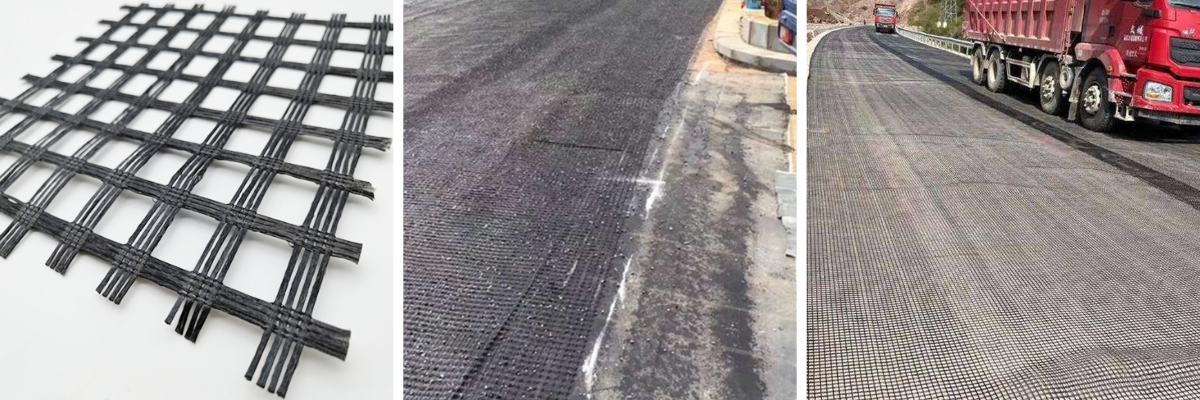
Fiberglass Geogrid Extends Service Life of Urban Arterial Road
Fiberglass Geogrid Extends Service Life of Urban Arterial Road
Project Background
This is a reconstruction project of an urban arterial road characterized by heavy traffic volume and a high proportion of heavy trucks. The original pavement developed numerous transverse cracks, longitudinal cracks and subsidence. The reconstruction scheme includes milling off the damaged layer of the old pavement, laying fiberglass geogrid, and overlaying a new asphalt surface course. Urban roads are subject to frequent start-stop operations and heavy braking loads, leading to rapid crack reoccurrence. The geogrid is adopted to retard crack propagation, reduce repeated maintenance and cut municipal maintenance costs.
Specification and Quantity
Type: Self-adhesive Fiberglass Geogrid
Specification: Tensile strength 80kN/m, elongation ≤3%, aperture size 25.4×25.4mm
Net laying area: 45,000 ㎡
Loss factor for junctions and intersections: 10%
Total purchasing quantity: 49,500 ㎡
Functions
✅ Reflective crack resistance: Block upward reflection of cracks from the original base layer.
✅ Rutting and shoving resistance: Improve the overall shear resistance of asphalt mixture and reduce shoving and rutting at braking zones of intersections.
✅ Disperse concentrated wheel loads and lower stress level of the underlying pavement.
Construction Parameters
Substrate treatment: Milling and cleaning; patching and compaction at damaged positions.
Laying: The main force-bearing direction of the geogrid is transverse to the road; overlap width ≥10 cm.
Fixation: Self-adhesion as the primary method; U-shaped nails shall be densely arranged at heavy-load intersections with spacing of 1.5 m.
Asphalt paving: Paving temperature 155~175℃, compact at a constant speed to prevent wrinkling and displacement of the geogrid.
Construction shall be avoided on rainy days; the base surface shall be dry and free of ponding.