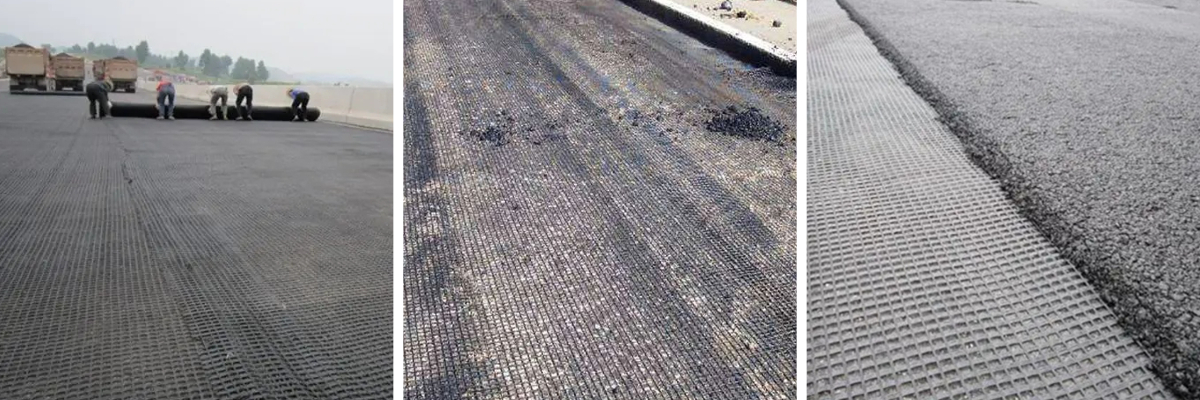
Engineering Case of Fiberglass Geogrid for Airport Pavement Reinforcement
Engineering Case of Fiberglass Geogrid for Airport Pavement Reinforcement
Project Background
This is an expansion and reconstruction project of airport taxiways and connecting taxiways. The existing old cement concrete pavement suffers from slab cracking, pumping and faulting. A "white to black" reconstruction scheme is adopted, with an asphalt overlay paved on the old concrete slabs. Airport pavement is subject to frequent heavy aircraft loads and repeated impact loads. Reflective cracks are highly prone to initiate upward at the joints of old slabs and penetrate the asphalt surface course rapidly, impairing pavement smoothness and flight safety and greatly shortening the overhaul cycle. Self-adhesive fiberglass geogrid is applied as a stress-absorbing and reinforcement layer to restrain reflective cracking and improve the overall fatigue resistance of the pavement.
Specification and Quantity
Type: Self-adhesive Fiberglass Geogrid
Specification: Tensile strength 100kN/m, elongation ≤3%, aperture size 25.4mm×25.4mm, temperature resistance compatible with asphalt paving temperature and good compatibility with asphalt.
Net laying area: 28,600 ㎡
Loss factor for seams and edge corners: 9%
Total purchasing quantity: 31,174 ㎡
Functions
✅Stress dispersion and reflective crack control: Block the upward transmission of concentrated stress at joints of old concrete slabs, absorb deformation stress and prevent cracks from propagating upward into the asphalt surface course.
✅ Reinforcement: Improve the overall tensile capacity of the asphalt layer, resist repeated fatigue loading from aircraft wheel loads and reduce the risk of asphalt shoving and bulging.
✅ Auxiliary interlayer bonding: Self-adhesive structure with excellent adhesion to asphalt to reduce interlayer slippage.
Construction Parameters
Old pavement pretreatment: Remove laitance and debris, repair faulting and voids, and seal cracks by grouting.
Laying direction: The main force-bearing direction of the geogrid shall be perpendicular to slab joints.
Overlap width: Longitudinal overlap ≥10 cm, transverse overlap ≥15 cm.
Fixation method: Self-adhesion assisted by U-shaped nails; spacing of fixing points: 1.5~2.0 m.
Asphalt paving: Asphalt shall be paved as soon as possible after geogrid laying. Paving temperature: 160~180℃. Do not drag the geogrid directly with paver tracks.
Heavy vehicles are prohibited from turning around on areas where geogrid has been laid but asphalt has not been paved.