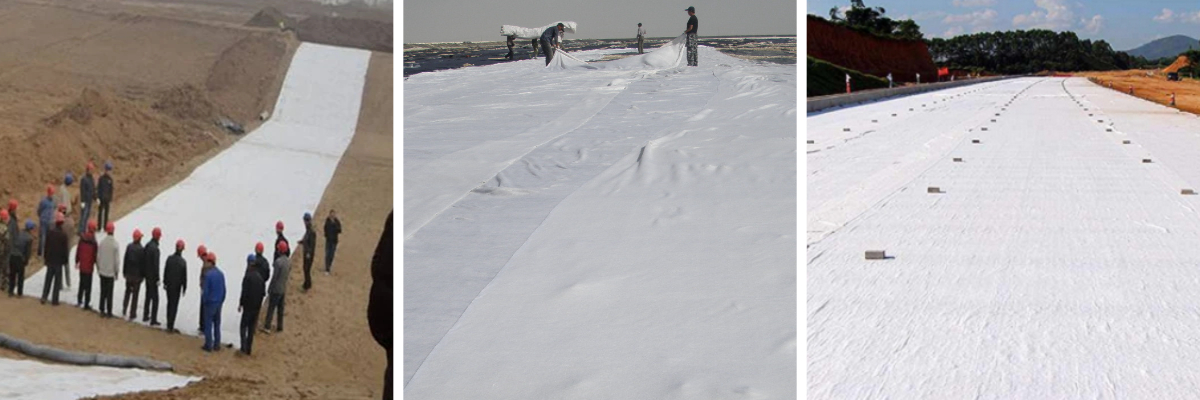
Application Cases of Geotextiles in Highway Construction
As a new type of geosynthetic material, geotextiles have been widely used in road construction due to their excellent performance in filtration, drainage, isolation, reinforcement, and seepage prevention. They are particularly suitable for engineering scenarios with complex geological conditions and high requirements for subgrade stability. This article elaborates on the specific applications, construction techniques, technical advantages, and practical outcomes of geotextiles in road construction, providing reference and guidance for similar highway projects.
1. Project Overview
The highway passes through areas with complex terrain. Some sections have a high groundwater table and are subjected to long-term heavy vehicle traffic, making the pavement prone to distresses such as reflective cracking, delamination between layers, and water damage, which seriously affect the service life of the road and traffic safety. To address these issues, after thorough technical evaluation, the engineering team decided to use polypropylene long-filament needle-punched geotextile as a crack-resistant interlayer in asphalt pavement construction. This fully leverages its functions of stress distribution, waterproofing, and interlayer bonding, thereby enhancing the structural stability and durability of the pavement.
2. Engineering Challenges and the Necessity of Geotextile Application
During construction, the project faced three core challenges that required innovative material solutions:
(1) Prominent Risk of Reflective Cracking
Some sections of the base layer were semi-rigid structures, which are prone to shrinkage cracks under temperature changes and traffic loads. Without effective intervention, these cracks propagate upward into the asphalt surface, causing pavement damage and water infiltration, significantly shortening the service life.
(2) High Risk of Water Damage
The project area has a high groundwater table, and rainwater easily infiltrates into the pavement base, leading to softening and strength loss of the base layer. This can cause pavement settlement, potholes, and other distresses, threatening traffic safety.
(3) Insufficient Interlayer Bonding
If the bond between the asphalt surface and the base layer is weak, interlayer slippage and delamination may occur, reducing the overall load-bearing capacity and failing to meet the demands of long-term heavy vehicle traffic.
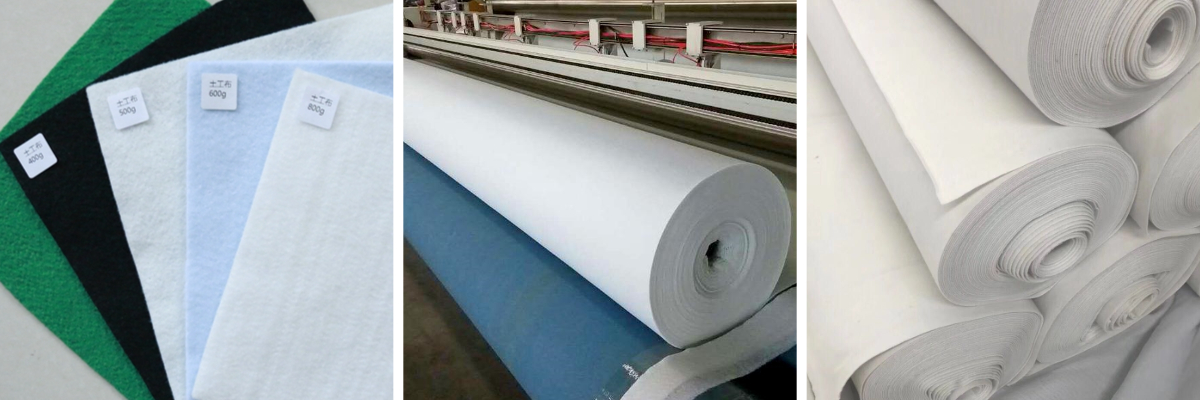
To address these challenges, polypropylene long-filament needle-punched geotextile was selected as the optimal solution due to its superior mechanical properties and functional characteristics:
·It has excellent ductility and flexibility, effectively distributing stress and suppressing crack propagation;
·It possesses certain waterproofing properties, preventing moisture penetration and protecting base stability;
·Its fibrous surface structure enhances bonding strength with both asphalt and the base layer, improving the integrity of the pavement structure and effectively resolving the above engineering challenges.
3. Geotextile Construction Procedures and Quality Control
In this project, the geotextile was primarily installed between the asphalt surface and the base layer. The construction strictly followed the sequence:
Base preparation → Geotextile laying → Fixation → Asphalt paving,
with strict control over key construction details to ensure effectiveness. The specific procedures are as follows:
(1) Base Preparation
Before construction, the base layer was thoroughly cleaned to remove debris, loose soil, and sharp stones that could puncture the geotextile. The base was then compacted and leveled to ensure:
·Surface flatness ≤ 5 cm,
·Compaction degree ≥ 92%,
·No standing water or loose particles.
This provided a smooth and solid foundation for geotextile installation. Existing cracks on the base surface were repaired in advance to prevent crack propagation into the geotextile and asphalt layers.
(2) Geotextile Laying
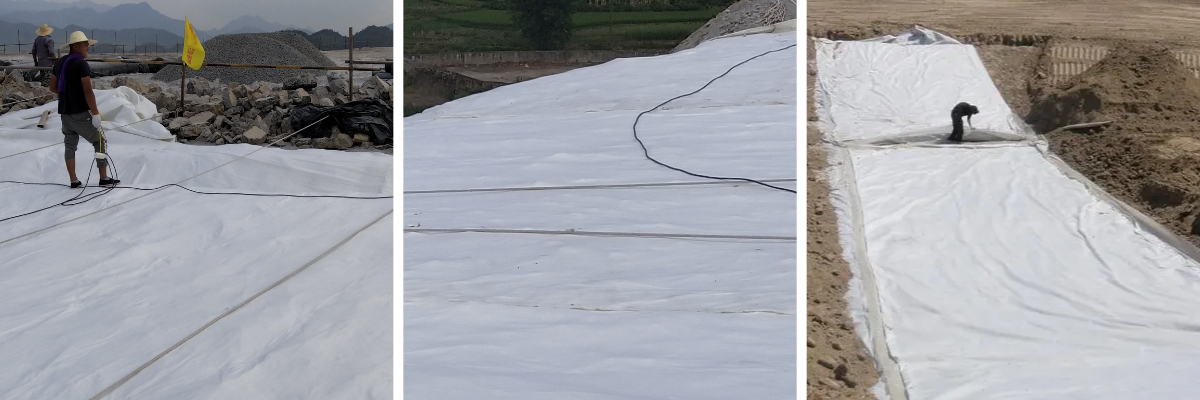
The geotextile was laid using a combination of mechanical equipment and manual assistance. During laying:
·The fabric must remain flat and taut, without wrinkles or slackness, to ensure effective stress distribution.
·Transverse overlap width ≥ 10 cm, longitudinal overlap width ≥ 15 cm.
·Overlapping joints were treated with hot-melt welding or adhesive bonding, with a bonding width ≥ 5 cm.
·Joint strength must reach ≥80% of the parent material strength to prevent water infiltration through seams.
The geotextile must be in close contact with the base layer, avoiding any suspension. Where necessary, it was secured with fixing pins at intervals of 1.0–1.5 m to ensure stability.
(3) Quality Inspection
After laying, a professional team conducted a comprehensive quality inspection, focusing on:
·Flatness,
·Overlap width,
·Bonding strength,
·Presence of damage or punctures.
Any issues such as wrinkles, looseness, or damage were promptly corrected. Poorly bonded or defective joints were re-welded or re-bonded to ensure compliance with design specifications.
(4) Asphalt Paving
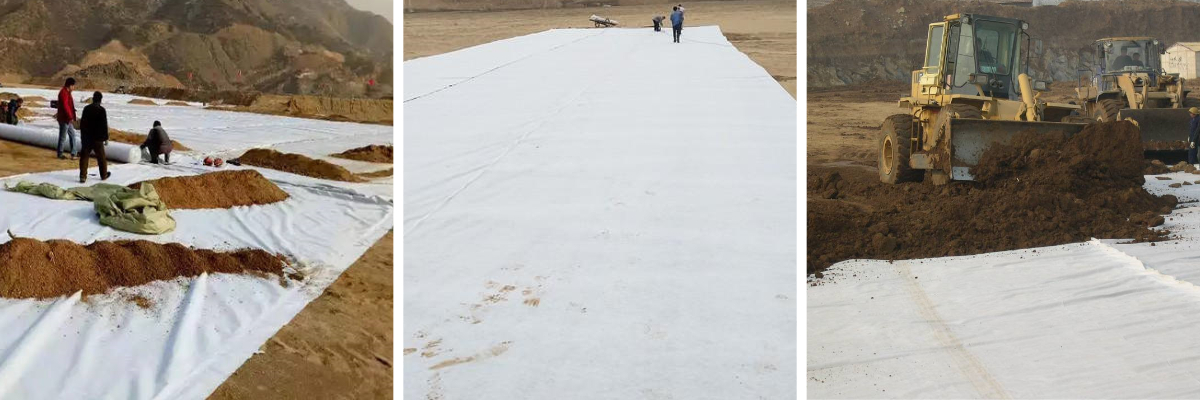
Once the geotextile passed quality inspection, asphalt paving was carried out immediately. Key controls included:
·Paving temperature: 130–150°C, to avoid thermal damage to the geotextile.
·Uniform paving speed to prevent roller-induced damage.
·Ensuring tight adhesion between the asphalt layer and geotextile to form an integrated structure, fully realizing the geotextile’s functions of crack resistance and waterproofing.
4. Case Summary
This case demonstrates the successful application of polypropylene long-filament needle-punched geotextile in highway construction, fully showcasing its superior performance in crack resistance, waterproofing, reinforcement, and interlayer bonding. It effectively addressed the core challenges of road construction under complex geological conditions and provides a practical reference for similar highway projects.
Practical results show that the rational selection and use of geotextiles in road construction not only enhance structural stability and durability, extend service life, but also reduce construction difficulty and long-term maintenance costs—offering both technical advancement and economic rationality.
With the continuous development of geosynthetic material technology, geotextiles will play an increasingly important role in road construction, providing strong support for the high-quality development of transportation infrastructure.