How to Select Suitable Geocell for Specific Application Scenarios
How to Select Suitable Geocell for Specific Application Scenarios
1. Key Factors to Determine Geocell Selection
Before choosing geocell types, confirm these core conditions:
1. Project function: Subgrade reinforcement / slope protection / river revetment / eco retaining wall
2. Environment: Dry site or humid/water fluctuation area; permanent or temporary construction
3. Load level: Light traffic, highway heavy load or only anti-erosion
4. Requirement: Need vegetation greening or purely aggregate stabilization
5. Foundation condition: Well-drained ground or saturated soft muddy soil
2. Classification Selection Guide by Geocell Structure
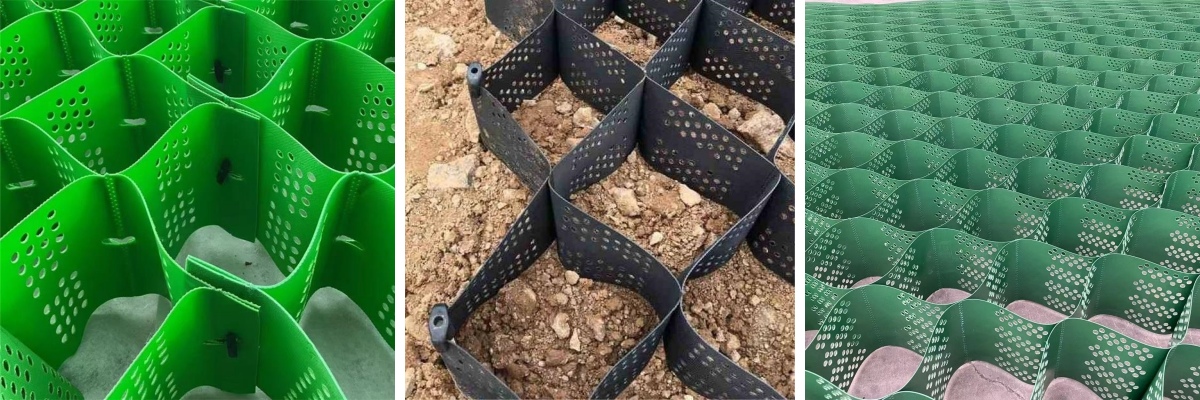
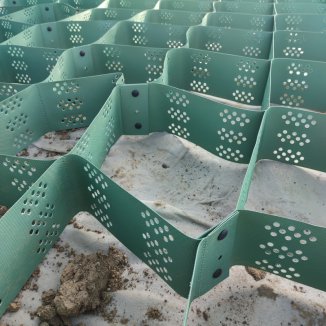
(1) Perforated Honeycomb Geocell
Best applicable scenarios
✅ Highway/railway cut & fill slope greening
✅ River, reservoir, channel ecological revetment, water level fluctuation zone
✅ Mine ecological restoration, landfill cover anti-slip slope
✅ Low-lying, poorly drained soft subgrade
✅ Landscape eco retaining wall
Reasons to choose:
Built-in drainage holes release pore water and hydrostatic pressure; plant roots penetrate holes to form soil-root-geocell composite reinforcement, achieving long-term ecological protection.
Recommended specifications
Slope & river project: Height 100–200 mm, sheet ≥1.2 mm
Heavy-load wet subgrade: Height 150–200 mm, sheet ≥1.5 mm, perforated textured surface
(2) Solid Textured / Embossed Geocell
Best applicable scenarios
✅ Dry heavy-duty road subgrade, highway widening sections
✅ Mine haul roads, container yards, logistics storage yards
✅ Permanent load-bearing foundation without vegetation requirements
Reasons to choose:
Embossed rough surface greatly improves friction between geocell and gravel aggregate, maximizes lateral confinement effect to resist heavy wheel load, effectively controls rutting and differential settlement.
Limitations:
No drainage capacity. Not allowed for waterlogged ground, slopes and waterfront areas.
(3) Solid Smooth Geocell
Best applicable scenarios
✅ Temporary construction roads
✅ Light temporary storage yards, short-term access roads
✅ Dry ground with low budget and low load demand
Limitations:
Low surface friction; not suitable for long-term heavy load and slope engineering.
3. Selection Standard Based on Working Condition
Scenario A: Road Subgrade Reinforcement
- Dry ground, heavy traffic → Solid textured geocell
- Low-lying, easy ponding soft foundation, medium load → Perforated textured geocell
- Temporary light access road → Solid smooth thin geocell
Scenario B: Slope Protection & Ecological Greening
General rule: Prioritize perforated geocell
- Gentle slope (<30°): Height 100mm perforated geocell
- Steep slope (>30°) or high fill embankment: Height 150–200 mm, thick sheet perforated geocell, high weld peel strength ≥10kN/m
Scenario C: Water Conservancy Revetment (River, Reservoir, Tidal Flat)
Must adopt perforated honeycomb geocell
Water level rise and fall will create buoyancy force; holes balance water pressure on both sides of the sheet to prevent uplift deformation. Solid geocell is prohibited for long-term waterfront works.
Scenario D: Temporary Projects (Short service life <5 years)
Can select thin PP geocell or thin HDPE solid geocell to save cost.
Scenario E: Permanent Infrastructure (Road, slope, revetment ≥50 years design life)
Must use virgin HDPE modified geocell with anti-UV and antioxidant additives.
4. Specification Matching Principles (Height, Thickness, Welding Pitch)
1. Height rule
Slope protection commonly uses 100/150 mm; subgrade reinforcement mostly adopts 150/200 mm; high-load yard up to 200–250 mm.
2. Sheet thickness rule
Light load / gentle slope:1.0–1.2 mm
General highway, river bank:1.2–1.5 mm
Heavy mine road, steep slope:1.5–1.8 mm
3. Welding pitch
Small pitch (330/400mm): higher integral rigidity, steep slope & heavy load
Large pitch (500/660mm): cost-effective, gentle slope and light load
5. Simple Summary Checklist
- Need greening / slope / river bank / damp ground → Perforated Geocell
- Dry ground, heavy vehicle load, no planting requirement → Solid Textured Geocell
- Temporary, dry, low load, cost-sensitive → Solid Smooth Geocell