YPEP high-strength woven geotextile~Soft soil foundation reinforcement project for airports
Facing the dual challenges of soft soil foundation settlement and repeated aircraft impact loads, a Chinese civil airport successfully applied high-strength woven geotextile as a key reinforcement material in foundation treatment for the runway extension and portions of the apron area. This effectively enhanced the pavement structure's integrity and long-term service performance. This paper systematically shares the technical details and application outcomes of this case study.
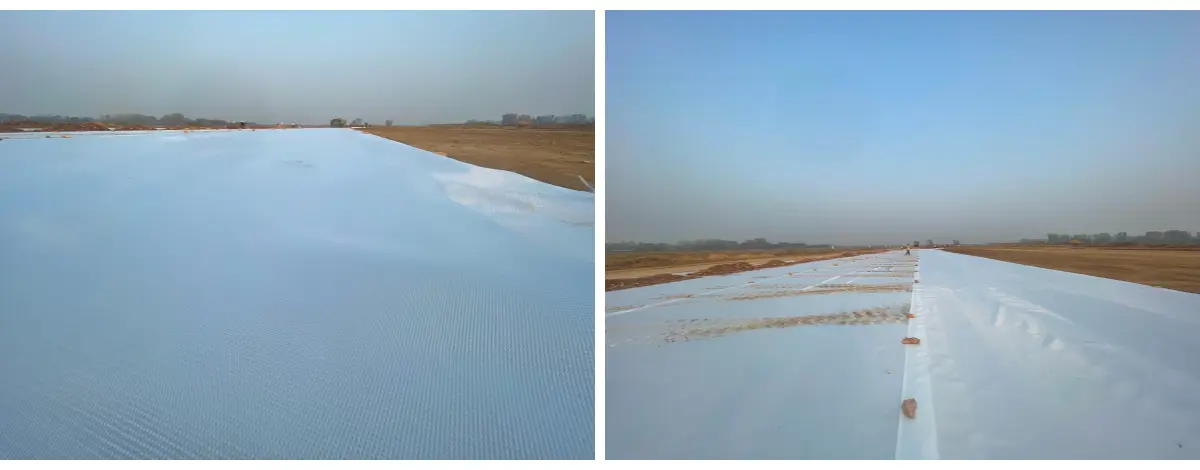
I. Project Overview: Safety Issues on Soft Ground
Situated on a coastal alluvial plain, the airport site is characterized by extensive, deep layers of silty, soft soil. Natural foundations have low load-bearing capacity and high compressibility, which poses a significant risk of post-construction settlement and uneven settlement. Without intervention, the massive repetitive dynamic loads from aircraft take-off and landing will accelerate fatigue failure of the subgrade, leading to pavement cracking and uneven settlement, which seriously threatens operational safety.
The main engineering challenge is to incorporate a high-strength “flexible mesh”, namely a high-strength woven geotextile, into the base of the structural layer of the pavement. This is implemented alongside traditional foundation treatment methods (e.g., drainage consolidation, gravel piles) to distribute loads and limit lateral movement. This approach allows local settlement to be controlled within millimeters, ensuring smoothness of the coating and structural strength.
II. Solution development: material selection and design
1. Selection of materials and main characteristics
Geotextiles made from polypropylene fiber were chosen for the project. This material is made of high-strength synthetic fibers in both warp and weft, which provides the following main advantages:
Exceptional mechanical strength: tensile strength, tear resistance, and puncture resistance significantly exceed those of needle-punched nonwoven geotextiles of similar weight. Its puncture resistance exceeds 2200 N, effectively resisting loads from penetration of aggregates and aircraft loads.
Exceptional Durability: Polypropylene has outstanding resistance to acid/alkali corrosion and mold growth, maintaining long-term stability in challenging groundwater conditions, equivalent to decades of airport service life.
Excellent engineering properties: a high coefficient of friction ensures a tight bond with the filler material, minimizing structural slippage. Moderate elongation allows for rapid stress distribution under load, promoting uniform load distribution.
2. Design principles
Geotextile is placed between the leveled base layer (after foundation treatment) and the crushed stone top layer. Its operating principles are as follows:
Reinforcement: The high tensile strength of geotextiles provides an additional "tensile membrane" effect for the initially loose subgrade material. When exposed to overhead loads, the geotextile absorbs and distributes stress through tensile deformation, suppressing potential shear slip between the base layer and the subgrade.
Separation function: acting as an elastic barrier, it effectively prevents the migration of weak fine-grained soils from the lower layers upward into the crushed stone layer. At the same time, it prevents the upper crushed stone layer from sinking into the soft foundation. This maintains the structural integrity of each layer, preventing a reduction in load-bearing capacity due to the mixing of materials.
III. Construction and installation: standardized processes and precise control
The effectiveness of high-strength woven geotextiles relies heavily on standardized construction methods. The following key procedures and quality control points were followed for this project:
1. Laying and overlapping
Preparation of the base: Before laying, the base (treated foundation) was carefully leveled and compacted, removing all sharp protrusions that could pierce the geotextile.
Lay-down direction: The principal direction of strength of the geotextile (usually longitudinal) coincides with the runway axis to maximize the resistance to the principal direction of stress during aircraft take-off and landing.
Overlapping method: Overlapping joints were used. In accordance with design specifications and standards, the overlap width was at least 30 cm. In critical stress zones, the overlap width exceeded 50 cm to ensure continuous stress transfer.
2. Stitching process
To form a highly integrated reinforced layer, this project uses dedicated on-site sewing machines.
Stitching Requirements: Continuous stitching using the "double thread and chain stitch method" is mandatory; spot stitching is strictly prohibited. The stitching thread must be made of high-strength polyester or polypropylene with a minimum tensile strength of greater than 60 N and chemical/UV resistance no less than that of the geotextile itself.
Quality control: The minimum distance between stitches from the fabric edge is 25 mm. Continuous inspection is required during construction; any missed stitches or broken threads must be immediately re-sewn and repaired. After stitching is complete, cover with filling material immediately to avoid prolonged exposure to UV light.
3. Laying and protecting the filling material
After laying and stitching the geotextile, immediately begin laying the top layer of gravel. The first layer of aggregate is placed using light machinery using the back-dump method, achieving a minimum thickness of 30 cm to prevent direct compaction and damage to the geotextile surface by heavy equipment. Compaction should be done from both sides towards the center, ensuring tension of the geotextile and its reliable adhesion to the overlying and underlying materials.
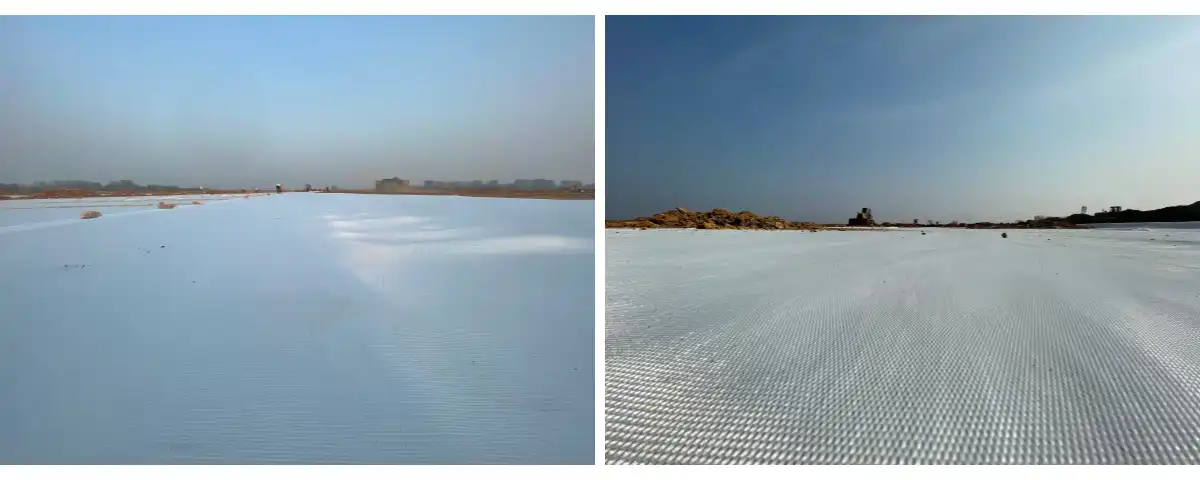
IV. Summary of the Key Benefits of High Strength Woven Geotextiles
Compared to traditional foundation treatment methods or conventional geosynthetics, the high-strength woven geotextiles used in this application demonstrate irreplaceable advantages:
| Advantage Parameter | Specific manifestation and engineering value |
|---|---|
| High mechanical properties | Extremely high tensile, tear and puncture strength provides a significant reinforcing effect on weak substrates, directly minimizing the risk of uneven settlement. |
| Durability and reliability | Polypropylene raw material has excellent resistance to chemical and biological influences, ensuring its stability throughout its life cycle in humid underground environments without the need for maintenance – a one-time investment, a lifetime benefit. |
| Efficiency and cost-effectiveness of construction | Factory-made materials ensure consistent quality; only installation and stitching are required on-site, the process is simple, and construction speed is high. High overall profitability and significant savings in material and time costs compared to traditional methods are achieved. |
| Significant comprehensive benefit | By improving the integrity of the road base, the service life of the road surface is effectively extended, frequent major repairs and disruptions due to future settlement problems are reduced, resulting in enormous social and economic benefits. |
Thus, for this airport's soft-ground foundation strengthening project, high-strength woven geotextiles represent more than just a material choice, but the embodiment of an effective and durable design philosophy. It uses flexibility to overcome rigidity, seamlessly combining "high strength" with "flexibility". This approach provides an indispensable engineering solution to ensure the safe and stable operation of modern aviation hubs in difficult geological conditions.